Understanding accounts payable helps business owners manage working capital, maintain strong supplier relationships, avoid late payment penalties, and capture profitable early-payment discounts. It also provides a structured career pathway for professionals exploring corporate accounting and finance.
In this comprehensive guide, we will explore the core definition of accounts payable, its accounting mechanics and journal entries, how the operational invoice lifecycle functions, common accounts payable jobs, career paths, and the critical operational differences between accounts payable vs accounts receivable.
What Is Accounts Payable?
Accounts payable (AP) represents the short-term debts a business owes to its suppliers or vendors for goods and services that have been delivered but not yet paid for. In everyday business operations, accounts payable reflects a company’s outstanding commercial invoices.
For example, imagine a business purchases office furniture worth $2,000 from a commercial vendor. The supplier delivers the goods and extends trade credit with payment terms of Net 30 days, rather than demanding immediate cash on delivery. Until the company settles the balance, that $2,000 obligation sits in accounts payable.
Under standard accounting principles, accounts payable is classified as a current liability on the balance sheet because the obligation is expected to be settled within one operating cycle or 12 months, whichever is longer.
The accounts payable department serves as the operational guardian of outgoing company funds, ensuring that every vendor invoice is legitimate, verified against received goods, accurately recorded, and paid in accordance with established cash flow strategies.
What Does Accounts Payable Mean?
While the singular phrase account payable occasionally denotes an individual liability or vendor line item, the plural term accounts payable represents the total cumulative balance owed across all trade creditors.
For example, assume a corporation maintains the following outstanding vendor balances at month-end:
- $500 owed to an office supply vendor (due in 15 days)
- $1,200 owed to a software-as-a-service (SaaS) provider (due in 30 days)
- $3,000 owed to a raw material supplier (due in 60 days)
The company’s aggregate accounts payable balance on the balance sheet stands at $4,700. Monitoring this total ensures that executive leadership understands near-term liquidity commitments and avoids cash shortages.
Read Also: What Is a 1099 Employee? Meaning, Rules, and Tax Forms
Accounts Payable vs. Trade Payables: Key Differences
Although many accounting practitioners use the terms interchangeably, trade payables and accounts payable represent distinct categories on the corporate ledger under Generally Accepted Accounting Principles (GAAP):
- Trade Payables: Encompass obligations incurred exclusively for core inventory, raw materials, and production supplies directly tied to the primary revenue engine of the business (e.g., steel purchased by an automotive plant or fabric by an apparel maker).
- Accounts Payable: Serves as an umbrella liability account encompassing all operational vendor obligations. This includes trade payables as well as non-trade administrative, software, and capital expenditures (e.g., office equipment, accounting software licenses, legal counsel, and utility bills).
| Obligation Type | Category | Balance Sheet Classification | Standard Payment Terms |
| Direct Production Materials | Trade Payable | Current Liability | Net 30 to Net 90 |
| Enterprise ERP Software Subscription | Accounts Payable (Non-Trade) | Current Liability | Net 30 / Annual Advance |
| External Legal & Audit Services | Accounts Payable (Non-Trade) | Current Liability | Due on Receipt / Net 15 |
| Office Furniture & Equipment | Accounts Payable (Capital Expenditure) | Current Liability | Net 30 |
Accounting Treatment: Is Accounts Payable a Debit or a Credit?
In financial accounting, accounts payable operates under the rules of double-entry bookkeeping and the accrual accounting method (Bragg, 2026). Because accounts payable is a liability account, it carries a normal credit balance.
When a business receives a vendor invoice for goods or operating expenses on credit, the transaction is recorded as follows:
- Debit: Relevant Expense or Asset Account (e.g., Office Supplies Expense or Inventory) to reflect the increase in resources.
- Credit: Accounts Payable Liability Account to reflect the increase in money owed.
When the business settles the invoice via electronic funds transfer (EFT), Automated Clearing House (ACH), wire, or corporate check, the offsetting journal entry is executed:
- Debit: Accounts Payable (reducing the outstanding liability).
- Credit: Cash or Cash Equivalents (reducing the asset account).
Standard General Ledger Journal Entries for AP
| Lifecycle Stage | General Ledger Account | Debit Amount ($) | Credit Amount ($) | Accounting Rationale |
| 1. Invoice Received & Approved | Operating Expense / Inventory | $2,000 | – | Records asset addition or operational cost |
| Accounts Payable | – | $2,000 | Increases short-term balance sheet liability | |
| 2. Invoice Settlement via ACH | Accounts Payable | $2,000 | – | Decreases open liability balance to zero |
| Cash / Operating Bank Account | – | $2,000 | Decreases current asset (liquid cash) |
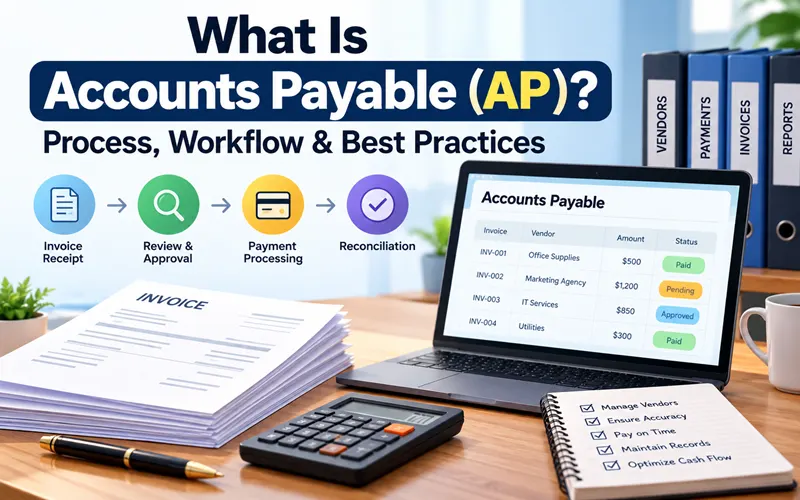
How Does Accounts Payable Work? The End-to-End AP Workflow
The accounts payable process follows a structured lifecycle designed to preserve working capital, maintain accurate books, and safeguard company assets against fraud and duplicate billing.
1. Purchase Requisition and Order Generation
The procurement process begins when an internal team identifies an operational need and generates an official Purchase Order (PO) outlining the items, approved quantities, and negotiated pricing, sent to the vendor.
2. Receiving Goods and Services
When the vendor fulfills the order, the company’s warehouse or receiving department inspects the shipment and issues a Receiving Report or Goods Received Note (GRN) confirming that physical delivery matches specifications.
3. Invoice Ingestion and Verification
The vendor transmits an invoice showing payment terms (such as Net 30 or 2/10 Net 30, offering a 2% discount if paid within 10 days). The AP team then performs mandatory invoice matching before routing for sign-off.
Internal Controls: Master Vendor Files & 3-Way Invoice Matching
Strong internal controls protect organizational capital from duplicate payments, inaccurate billing, and vendor impersonation fraud:
- Master Vendor File (MVF) Governance: Finance teams must maintain a centralized, authenticated Master Vendor File containing verified tax identification numbers, corporate addresses, and confirmed banking details. Strictly segregating duties ensures that the personnel authorized to add or edit vendor banking records cannot authorize disbursements.
- 2-Way Matching: Compares the Vendor Invoice line items, unit rates, and totals directly against the authorized Purchase Order. This is standard protocol for intangible services, SaaS licenses, and recurring professional retainers.
- 3-Way Matching: Cross-verifies the Vendor Invoice against both the authorized Purchase Order and the Receiving Report / GRN. This confirms three critical facts before any disbursement: the items were ordered, physically delivered without defect, and billed at the agreed contract price.
4. Recording the Liability (Vouchering)
Once the invoice passes internal validation, it is approved, assigned appropriate General Ledger (GL) account codes, entered into the Enterprise Resource Planning (ERP) or accounting system, and scheduled for payment.
5. Executing the Payment
The finance department disperses payment on the scheduled payment run via secure payment rails-such as corporate credit cards, ACH, bank transfers, or commercial checks-balancing supplier goodwill with optimal working capital retention.
6. General Ledger Reconciliation and Closing
The AP team reconciles supplier statements against the subledger and posts the payment, clearing the open liability from the accounts payable balance and reconciling bank transactions during month-end close.
Read Also: Top Green Startup Companies to Watch in 2026: Sustainable Business Models & Climate Leaders
Accounts Payable Software: Modernizing the Procure-to-Pay Cycle
Manual accounts payable workflows-reliant on paper invoices, manual data entry, and email routing-create processing bottlenecks, introduce human error, and delay month-end close. Modern finance teams implement accounts payable automation software integrated directly with Enterprise Resource Planning (ERP) environments (e.g., SAP S/4HANA, Oracle NetSuite, Microsoft Dynamics 365, Sage Intacct, and QuickBooks Online).
Core Capabilities of Enterprise AP Automation
- Optical Character Recognition (OCR) & Machine Learning: Automated systems extract vendor headers, line items, tax numbers, and invoice amounts with high accuracy, eliminating manual keypunch errors.
- Automated General Ledger (GL) Coding: Using historical transactions and vendor rules, the system pre-populates GL account, cost center, and project codes for review.
- Automated Multi-Way Matching: Algorithms cross-reference invoice items against purchase orders and electronic receiving receipts, automatically clearing verified invoices while routing discrepancies into dedicated exception queues.
- Digital Approval Hierarchies: Invoices route to budget owners according to predetermined financial approval limits, speeding up cycle times.
- Integrated Electronic Disbursements: Modern systems support automated clearing house (ACH) batches, international wire routing, and single-use Virtual Cards (vCards) that generate cash-back rebate revenue on corporate disbursements.
Manual vs. Automated AP Operations
| Operational Metric | Manual AP Workflow | Automated AP Platform |
| Cost to Process per Invoice | $12.00 – $16.00 | $2.50 – $4.00 |
| Average Processing Time | 8 to 15 Business Days | 1 to 3 Business Days |
| Error & Duplicate Payment Rate | High (Human entry discrepancies) | Near Zero (Automated duplicate detection) |
| Discount Capture Rate | Under 20% (Missed Net 10 windows) | Over 90% (Accelerated cycle times) |
| Audit Readiness | Manual paper filing & search | Centralized digital audit trail |
Key Financial Metrics: The Accounts Payable Turnover Ratio
Accounts payable management directly affects a company’s cash conversion cycle and operational liquidity (Financial Professionals, 2026). Financial analysts evaluate AP health using two primary metrics:
1. Accounts Payable Turnover Ratio
This liquidity metric calculates how many times a company pays off its trade suppliers over a specified accounting period:
Accounts Payable Turnover Ratio – Total Net Credit Purchases/Average Accounts Payable
Average Accounts Payable – (Beginning AP+Ending AP)/2
- A high turnover ratio indicates that a company settles debts rapidly, which may signify strict credit terms or a strategy to capture early-payment discounts (Financial Professionals, 2026).
- A low turnover ratio suggests that a company takes longer to settle debts, which conserves short-term cash but could point to liquidity strain or deteriorating vendor credit terms (Financial Professionals, 2026).
2. Days Payable Outstanding (DPO)
DPO measures the average number of days it takes a business to pay its operational invoices:
DPO=Average {Accounts Payable/Cost of Goods Sold(COGS)} x 365
Balancing DPO is essential: extending DPO improves operating cash flow, but excessive delays risk vendor friction, supply interruptions, and credit rating downgrades.
3. Ending Accounts Payable Balance Formula
To project balance sheet liabilities and model upcoming cash outflows, corporate controllers use the ending accounts payable formula:
Ending Accounts Payable = Beginning AP+New Credit Purchases – Cash Disbursements
Accounts Payable Jobs, Roles & Career Progression
Accounts payable teams are fundamental to corporate finance departments across all sectors, offering well-defined career trajectories from operational entry-level roles to executive leadership. Candidates exploring accounts payable jobs encounter several distinct job functions:
Accounts Payable Clerk
An accounts payable clerk handles high-volume data entry, logs incoming invoices into the accounting system, checks documentation completeness, files tax vouchers, and directs vendor payment status queries. According to the U.S. Bureau of Labor Statistics (2026), bookkeeping, accounting, and auditing clerks earn a median annual wage of $50,670, serving as a primary entry point into corporate finance.
Accounts Payable Specialist
An AP specialist takes on deeper operational duties, managing complex 3-way matching, investigating invoice discrepancies, reconciling complex vendor accounts, preparing weekly payment batches, and handling year-end vendor tax documentation (such as Form 1099 compliance).
Accounts Payable Analyst
An accounts payable analyst audits procurement-to-pay trends, monitors key performance indicators (such as cost-per-invoice and DPO), identifies payment bottlenecks, evaluates early-payment discount yields, and assists with month-end financial accruals.
Accounts Payable Manager / Controller
An AP manager oversees the complete payables staff, enforces internal accounting controls, manages external audit relationships, sets corporate disbursement policies, and leads AP automation integrations with enterprise platforms.
Corporate AP Competency & Compensation Framework
| Position Title | Experience Level | Core Systems & Technical Stack | Primary Responsibilities | U.S. Salary Benchmark |
| Accounts Payable Clerk | Entry-level (0–2 yrs) | Excel, QuickBooks, Document Capture | Data entry, voucher prep, invoice scanning | $42,000 – $52,000 |
| Accounts Payable Specialist | Mid-level (2–5 yrs) | NetSuite, Sage Intacct, Tipalti, Stampli | 3-way matching, vendor reconciliations, 1099s | $54,000 – $68,000 |
| Accounts Payable Analyst | Mid-to-Senior (3–6 yrs) | SAP, Power BI, Advanced Modeling | DPO modeling, spend analytics, audit reporting | $65,000 – $82,000 |
| Accounts Payable Manager | Management (6+ yrs) | Enterprise ERPs, P2P Systems, Banking APIs | Team leadership, internal controls, cash flow policy | $85,000 – $115,000+ |
Core Skills and Technologies Required for AP Careers
Succeeding in accounts payable jobs requires a mix of accounting fundamentals, analytical skills, and hands-on software experience:
- Accounting Knowledge: Solid grasp of accruals, balance sheet liabilities, debits and credits, and standard charts of accounts.
- Spreadsheet Proficiency: Working with Microsoft Excel or Google Sheets (VLOOKUP/XLOOKUP, pivot tables, and conditional formatting) for account reconciliations.
- ERP and Accounting Software: Hands-on experience with modern platforms such as Oracle NetSuite, SAP S/4HANA, Microsoft Dynamics 365, QuickBooks Enterprise, or Sage Intacct.
- Accounts Payable Automation Systems: Familiarity with modern procure-to-pay (P2P) automation platforms that deploy Optical Character Recognition (OCR) and automated approval routing.
- Attention to Detail and Fraud Detection: Reviewing banking information, validating tax identifiers, detecting duplicate billing, and preventing business email compromise (BEC) wire fraud.
Evaluating Accounts Payable Vacancies and Career Pathways
Job seekers reviewing accounts payable vacancies should evaluate how open roles balance manual transactional tasks with automated systems:
- Assessing Job Descriptions: Competitive accounts payable vacancies prioritize experience with ERP systems, automated matching platforms, and electronic payment rails over pure manual invoice processing.
- Professional Credentials: Credentials such as the Certified Accounts Payable Professional (CAPP) or Certified Accounts Payable Associate (CAPA) validate mastery of regulatory compliance, sales and use tax, internal controls, and automation design.
- Quantifying Impact on Applications: When applying for open accounts payable vacancies, highlight specific business outcomes on your resume-such as weekly invoice processing volumes, reductions in exception backlogs, and early-payment discounts captured.
Accounts Payable vs. Accounts Receivable
While both functions are central to working capital management, accounts payable vs accounts receivable represent opposite sides of commercial credit transactions.
Accounts payable represents money a business owes to its suppliers (a liability), whereas accounts receivable (AR) represents money customers owe to the business for delivered products or services (an asset).
| Feature | Accounts Payable (AP) | Accounts Receivable (AR) |
| Financial Nature | Money the company owes to external vendors | Money owed to the company by customers |
| Balance Sheet Category | Current Liability | Current Asset |
| Normal Balance | Credit | Debit |
| Primary Operational Goal | Verify liabilities and optimize outgoing cash | Accelerate collections and shorten cash cycles |
| Key Performance Indicator | Days Payable Outstanding (DPO) | Days Sales Outstanding (DSO) |
| Trigger Event | Purchasing inventory or services on credit | Selling products or services on credit |
| Key Risk | Overpayments, duplicate billing, and fraud | Customer default, bad debt, and aging balances |
Practical Scenario: AP vs. AR in Action
- Accounts Payable Perspective: A retail business purchases $1,000 worth of store fixtures from a manufacturer on Net 15 terms. Until payment clears, the retail business logs a $1,000 credit in accounts payable.
- Accounts Receivable Perspective: For the fixture manufacturer, that exact same transaction represents an open billing claim. The manufacturer records a $1,000 debit in accounts receivable until customer payment arrives.
Coordinating both functions enables finance executives to maintain an optimal cash conversion cycle-ensuring inbound collections from accounts receivable adequately fund outbound obligations in accounts payable.
Why Is Accounts Payable Critical for Enterprise Health?
Managing accounts payable effectively extends well beyond processing paper checks; it is a core operational lever for strategic liquidity:
- Strategic Working Capital Optimization: Aligning payments with agreed credit terms preserves operating liquidity for capital investments and debt obligations.
- Supplier Goodwill and Credit Standing: Reliable, on-time payments establish credibility with key vendors, enabling better bulk pricing, extended credit limits, and priority fulfillment during supply chain disruptions.
- Internal Control and Fraud Mitigation: Implementing structured invoice verification and strict segregation of duties protects corporate funds from fraudulent billing, employee collusion, and accidental overpayments (Bragg, 2026).
- Capturing Early-Payment Discounts: Timely invoice processing enables businesses to take advantage of favorable credit terms (e.g., 2/10 Net 30), which can generate substantial annualized cost savings.
- Accurate Financial Planning and Compliance: Clean subledgers ensure that expenses are recognized in the correct accounting periods under accrual standards, providing leadership with clear visibility into current liabilities.
Frequently Asked Questions (FAQs)
Accounts payable is a liability account and carries a normal credit balance. In double-entry accounting, it is credited when a business receives an approved vendor invoice (recording an increase in debt) and debited when the payment is made (reducing the outstanding debt).
Accounts payable is a current liability, not an expense. The expense is recorded on the income statement when the good or service is incurred; accounts payable records the balance sheet obligation to pay for that expense if purchased on credit.
The core operational AP lifecycle consists of:
1. Invoice Capture & Matching: Extracting invoice data and performing 2-way or 3-way matching against purchase orders and receiving reports.
2. Approval & GL Vouchering: Routing the verified invoice through the approval matrix and recording the liability in the general ledger.
3. Disbursement & Reconciliation: Executing electronic or check payments according to agreed credit terms and reconciling bank statements.
Three-way matching is an internal accounting control that cross-references three documents before payment approval: (1) the buyer’s Purchase Order, (2) the receiving department’s Goods Received Note / Packing Slip, and (3) the vendor’s Commercial Invoice. This ensures the company only pays for items authorized and delivered without discrepancies.
A high accounts payable turnover ratio indicates that an organization pays suppliers quickly, which can secure early-payment discounts and build strong vendor relationships, but may tie up working capital. A low turnover ratio means the business takes longer to disburse payments, preserving cash reserves; however, an excessively low ratio can indicate liquidity challenges or risk vendor friction.