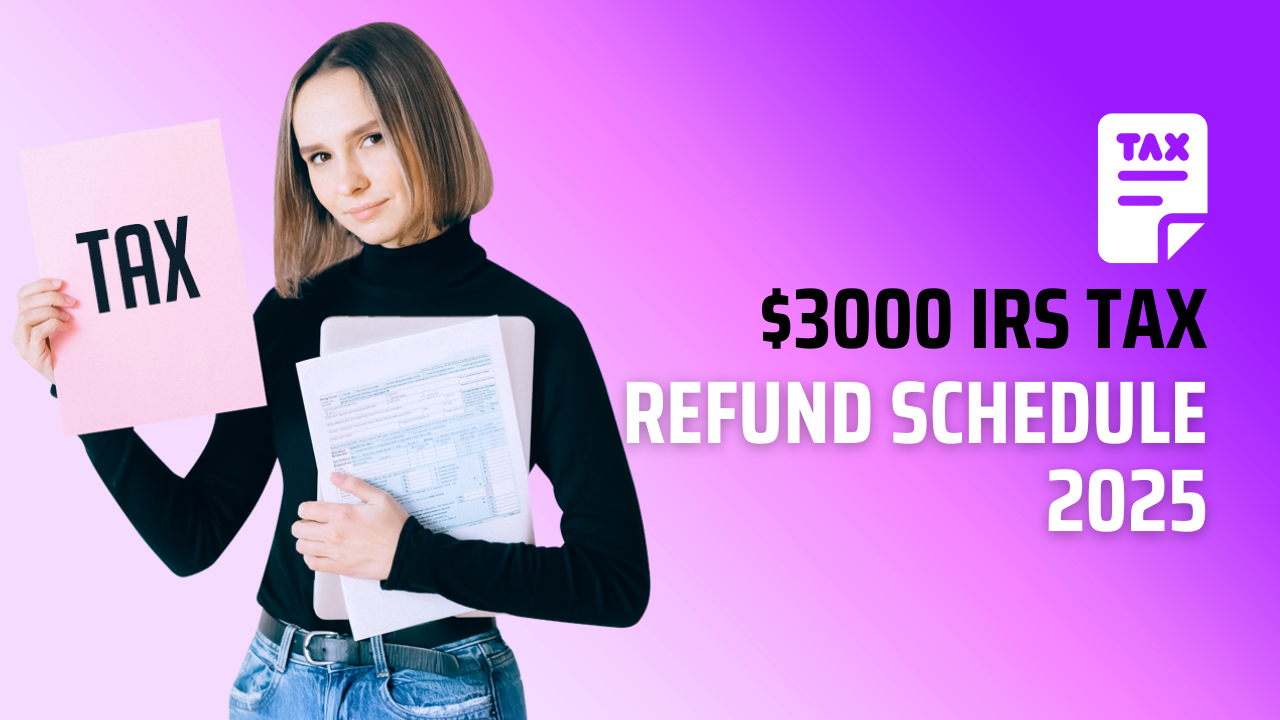
For millions of Americans, the annual tax refund is the largest single “paycheck” of the year. The 2025 tax season officially launched on January 27, 2025, and while the IRS aims to issue most refunds within 21 days, specific filing conditions can significantly alter this timeline. If you are tracking the $3000 IRS tax refund schedule 2025, understanding the intersection of tax credits, anti-fraud laws, and digital payment shifts is essential for accurate financial planning.
Quick Facts: $3,000 IRS Tax Refund 2025 – At a Glance
| Key Detail | Information |
| Standard Refund Window | 8-21 Business Days (e-file + Direct Deposit) |
| $3,000 Qualification | Calculated via CTC, EITC, and Over-withholding |
| PATH Act Hold Date | Refunds held until February 15 for EITC/ACTC filers |
| June 2025 Delays | Common for amended returns or ID verification issues |
| Refund Interest | Paid by IRS if delay exceeds 45 days past April 15 |
What Is the $3,000 IRS Tax Refund and Who Qualifies?
It is important to clarify that a “$3,000 refund” is not a specific government stimulus check. Instead, it represents the average refund threshold for households claiming high-value credits. When searching for the $3000 IRS tax refund schedule 2025 who qualifies, you should evaluate your eligibility for the following:
- The Child Tax Credit (CTC): For tax year 2024, the credit is worth up to $2,000 per qualifying child. If your tax liability is zero, you can still receive up to $1,700 as a refund per child via the Additional Child Tax Credit (ACTC).
- Earned Income Tax Credit (EITC): This is a powerful tool for low-to-moderate-income earners. A family with three children could receive a maximum credit of $7,830, easily pushing a refund well past the $3,000 mark.
- The “Interest-Free Loan” (Over-withholding): If your W-4 settings resulted in too much tax being taken from your weekly pay, the IRS simply returns your own money. A $3,000 refund essentially means you overpaid the government by $250 every month.
IRS $3,000 Tax Refund June 2025 Schedule: Why the Delay?
Many taxpayers find themselves searching for the irs $3000 tax refund june 2025 schedule because their payment has stalled. If your refund has not arrived by June, it is rarely a “lost” payment; rather, it is likely held in the IRS Error Resolution System (ERS) or requires manual intervention.
1. The PATH Act Mandate
By law, the IRS cannot release refunds that include EITC or ACTC before mid-February. This law, the Protecting Americans from Tax Hikes (PATH) Act, was designed to give the IRS more time to verify the validity of these high-value claims to prevent fraud. If you filed in late March or April, this initial backlog can ripple through the system, pushing some complex returns into June.
2. Identity Verification (Letter 5071C)
If the IRS flags a return as potentially suspicious, they will stop the refund and mail Letter 5071C. You must verify your identity online or via phone before the 21-day processing clock even begins.
3. Mismatched Information
A common reason for June delays in the $3000 IRS tax refund schedule 2025 is a mismatch between the return and Social Security Administration (SSA) records. This often happens after a name change due to marriage or if a dependent’s SSN is entered incorrectly.
How to Decode Your Refund Status: Common IRS Codes
To get more granular than the standard “Processing” message, expert filers look at their Tax Transcript for specific codes. The presence of these codes can tell you exactly where your money is:
- Code 846 (Refund Issued): The holy grail of codes. This signifies your refund has been scheduled.
- Code 570 (Additional Account Action Pending): This indicates a hold. The IRS is manually reviewing a portion of your return.
- Code 971 (Notice Issued): The IRS has mailed you a letter explaining a change or a request for more info.
- Code 810 (Refund Freeze): A more serious hold often related to identity or high-risk credit claims.
The Move to Digital: Direct Deposit and EO 14247
The IRS is strictly enforcing a move toward electronic payments in 2025. Under Executive Order 14247, the government is phasing out the mailing of paper checks due to the high cost and risk of mail fraud.
If you are “unbanked,” you should use a prepaid debit card that offers a routing and account number. If the IRS attempts a deposit and fails, they will issue a CP53E notice, giving you a 30-day window to provide a new digital account.