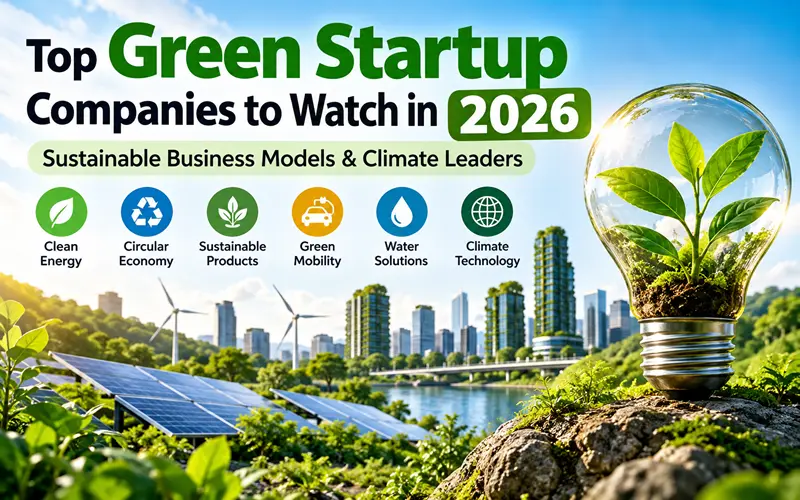
From AI-driven circular supply chains to grid-scale battery storage, innovative green startup companies are transforming industrial decarbonization into commercially viable, cash-flow-positive enterprises. While early clean-tech ventures struggled with high capital intensity, modern market entrants pair deep technological innovation with scalable unit economics and disciplined balance sheet management. This 2026 industry brief profiles standout green startup companies, details their unit economics, maps institutional funding mechanisms, and provides an operational blueprint for scaling an eco-friendly enterprise.
What Are Green Startup Companies?
A green startup company is an early-stage commercial enterprise that engineers proprietary products, software, or industrial technologies to solve environmental challenges while generating scalable unit margins. Operating across clean energy, circular manufacturing, and agritech, viable green startup companies tie core revenue expansion directly to verified emissions reduction, resource efficiency, and circularity.
To qualify as a genuine sustainable enterprise, a venture must substantiate its environmental claims beyond superficial branding. The operational framework requires four objective benchmarks:
- Core-Revenue Alignment: Environmental benefits must scale symmetrically with gross receipts. If revenue growth creates proportional ecological degradation, the venture does not qualify.
- Verified Life Cycle Assessment (LCA): Operations must demonstrate measurable Scope 1, Scope 2, or Scope 3 greenhouse gas (GHG) reductions under ISO 14040/14044 verification, avoiding secondary pollution or burden-shifting (International Organization for Standardization [ISO], 2006).
- Resource Efficiency & Circularity: The deployment of closed-loop material flows, depolymerization feedstocks, bio-based inputs, or energy optimization that diverts virgin finite resources (Ellen MacArthur Foundation, 2021).
- Regulatory Defensibility: Product architectures designed to fulfill evolving international frameworks, such as the EU Corporate Sustainability Due Diligence Directive (CSDDD) and SEC climate disclosure rules (European Commission, 2024; U.S. Securities and Exchange Commission [SEC], 2024).
Why Are Green Startup Companies Growing?
The acceleration of green startup companies stems from fundamental structural shifts in global capital allocation, corporate procurement mandates, and technology cost curves rather than consumer sentiment alone.
The Decarbonization Value Chain
- Institutional Capital Realignment: Global clean energy and transition technology investment reached approximately $2 trillion, outpacing fossil fuel commitments (International Energy Agency [IEA], 2024). Institutional allocators prioritize climate-aligned assets to de-risk portfolios against systemic carbon transition liabilities.
- Corporate Scope 3 Procurement Demands: Enterprises bound by European and international sustainability reporting standards must systematically lower Scope 3 supply chain footprints (European Commission, 2024). This creates multi-year enterprise demand for emerging green startup companies producing verified low-carbon alternatives.
- Declining Hardware Cost Curves: Levelized cost parity across solar, wind, advanced electro-chemistry, and biological synthesis allows innovative ventures to compete directly with fossil-derived commodities on a pre-subsidy basis (BloombergNEF, 2023).
- Targeted Industrial Subsidies: Strategic government capital deployment-including non-dilutive grant facilities like the US Department of Energy’s ARPA-E, Title 17 Clean Energy Financing, and the EU Innovation Fund-insulates early-stage ventures from balance sheet distress (European Commission, 2023; U.S. Department of Energy [DOE], 2023).
Primary Categories of Green Startup Companies
The climate and sustainability landscape spans four distinct industrial categories, each marked by unique capital expenditures, unit margins, and deployment timelines:
| Industrial Sector | Core Focus Areas | Representative Technologies | Primary Capital Profile |
| Clean Energy & Storage | Dispatchable power, grid stability, DER integration | Metal-hydrogen batteries, Virtual Power Plants (VPPs) | High CapEx; infrastructure debt & project finance |
| Circular Economy & Materials | Virgin resource displacement, closed-loop supply | Chemical depolymerization, enzymatic synthesis | Medium-to-high CapEx; equipment leases & blended equity |
| Sustainable Food & AgTech | Decoupling yield from petrochemical inputs | Soil microbiome genomics, precision bio-inputs | Asset-light SaaS paired with bio-fermentation CapEx |
| Industrial Decarbonization & DAC | Hard-to-abate point emissions (steel, cement, fuels) | Ambient-temp electrolysis, syngas carbon recycling | Very high CapEx; long-term project debt & off-take agreements |
1. Clean Energy Generation & Grid Optimization
This sector focuses on dispatchable decarbonized power, virtual power plants (VPPs), and distributed energy management. Software-first startups optimize distributed energy resources (DERs), while hardware ventures develop next-generation thermal, hydrogen, and long-duration stationary storage architectures to alleviate grid curtailment.
2. Circular Economy & Advanced Materials
Ventures in this vertical eliminate virgin extractive resources through continuous industrial loops. Focus areas include chemical depolymerization of complex plastics, post-consumer polymer upcycling, rare earth element recovery from electronics scrap, and high-performance biopolymers derived from agricultural sidestreams (Ellen MacArthur Foundation, 2021).
3. Sustainable Agriculture & Resilient Food Systems
Agritech startups decouple agricultural production from synthetic, petrochemical fertilizers and land expansion. Key innovations involve soil DNA sequencing to optimize biological fertilizer deployment, precision fermentation for functional protein synthesis, autonomous robotic weed management, and methane-inhibiting livestock feeds.
4. Carbon Transformation, Direct Air Capture (DAC) & Heavy Industry Abatement
Targeting recalcitrant industrial emissions, these companies address steel, concrete, aviation, and bulk chemicals. Methodologies balance point-source carbon capture, Direct Air Capture (DAC) coupled with permanent geological mineralization, and novel electrochemical synthesis utilizing captured carbon oxides as industrial feedstocks.
Read Also: Basis Points (BPS): Meaning, Calculation, and Conversion Guide
Top Green Startup Companies Leading the Market in 2026
To understand where capital allocators and enterprise buyers are directing resources, we examine ten fast-scaling green startup companies across software, industrial chemistry, and infrastructure deployment:
1. Solugen
- Headquarters: Houston, Texas, USA
- Total Funding: $650M+ (Series D & Federal Loan Guarantees)
- Core Commercial Offering: Bio-based drop-in organic chemical synthesis.
- Business Model: Direct B2B material supply via modular synthesis facilities (Bioforges).
- Environmental Impact Metric: Abates greenhouse gas emissions by up to 90% compared to traditional petrochemical pathways on a per-kilo basis when powered by renewable electricity (Solugen, 2023).
- Financial & Strategic Analysis: Solugen engineers proprietary enzymatic catalysts to convert domestic corn syrup and biogenic feedstocks into industrial chemicals (such as glucaric acid). By utilizing modular mini-plants instead of multi-billion-dollar petrochemical complexes, they preserve attractive unit economics and reduce transportation-linked Scope 3 logistics overhead.
2. EnerVenue
- Headquarters: Fremont, California, USA
- Total Funding: $750M+ (Series B, Growth Equity, and Credit Facilities)
- Core Commercial Offering: Nickel-hydrogen stationary battery storage for utility, commercial, and industrial deployment.
- Business Model: Direct CAPEX hardware sale with extended reliability and multi-cycle warranty packaging.
- Environmental Impact Metric: Eliminates reliance on toxic cobalt and scarce lithium chemistries, engineered for an operational lifespan exceeding 30,000 duty cycles.
- Financial & Strategic Analysis: While lithium-ion dominates electric mobility, EnerVenue targets utility stationary storage. Its nickel-hydrogen battery technology-previously restricted to aerospace applications-operates safely between -40°C and 60°C without supplemental cooling, dramatically lowering the levelized cost of storage (LCOS).
3. Twelve
- Headquarters: Berkeley, California, USA
- Total Funding: $645M+ (Blended Series C, Project Equity, and Debt Facilities)
- Core Commercial Offering: Electrochemical carbon transformation systems producing sustainable aviation fuel (E-Jet) and industrial chemicals from atmospheric CO2.
- Business Model: Industrial project finance, equipment licensing, and direct long-term commercial off-take agreements.
- Environmental Impact Metric: Demonstrates lifecycle emissions abatement of up to 90% across aviation and specialty chemicals relative to fossil baseline fuels (Twelve, 2024).
- Financial & Strategic Analysis: Twelve manufactures proprietary membrane electrode assemblies (MEA) that run on water and renewable electricity to transform CO2 into syngas and aviation fuels. They mitigate high initial CapEx by executing binding multi-year enterprise off-take agreements with airlines and enterprise logistics leaders.
4. Voltpost
- Headquarters: New York City, New York, USA
- Total Funding: $10M+ (Seed & Early Venture)
- Core Commercial Offering: Modular, curbside EV charging systems retrofitted directly into existing municipal street lighting poles.
- Business Model: Hardware-as-a-Service (HaaS) and municipal recurring maintenance contracts.
- Environmental Impact Metric: Reduces civil excavation requirements by up to 80% and accelerates urban fleet electrification across densely populated corridors.
- Financial & Strategic Analysis: Trenching city streets to install dedicated EV chargers often exceeds $100,000 per stall. Voltpost retrofits existing lamppost electrical architectures within two to three hours, drastically driving down urban CapEx deployment costs and municipal deployment friction.
5. Biome Makers
- Headquarters: West Sacramento, California, USA
- Total Funding: $25M+ (Series A & Growth)
- Core Commercial Offering: $\text{BeCrop}^\circledR$ technology-a proprietary platform for taxonomic DNA sequencing of soil microbiomes.
- Business Model: Tiered enterprise AgTech SaaS licensing and per-acre analytical diagnostic fee structures.
- Environmental Impact Metric: Optimizes synthetic nitrogen and phosphate application by identifying natural biological mineralization potential in soils.
- Financial & Strategic Analysis: Biome Makers leverages modern genomics to profile biological activity across millions of arable acres. Their biological asset databases serve enterprise agronomists, consumer packaged goods (CPG) suppliers, and global bio-fertilizer manufacturers seeking empirical field efficacy metrics.
6. Sublime Systems
- Headquarters: Somerville, Massachusetts, USA
- Total Funding: $120M+ (Series A, Corporate Strategic Equity, and Federal Grants)
- Core Commercial Offering: True zero-carbon, electrochemical hydraulic cement produced at ambient temperatures.
- Business Model: B2B commercial building material distribution and industrial site joint ventures.
- Environmental Impact Metric: Independent Life Cycle Assessment confirms its electrochemical production process avoids over 90% of standard Portland cement emissions by operating at ambient temperatures and bypassing carbonate decomposition (Climate Earth, 2023).
- Financial & Strategic Analysis: Traditional cement production accounts for roughly 8% of global greenhouse emissions through limestone calcination and fossil heating (Andrew, 2018). Sublime replaces thermal decomposition with an ambient-temperature electrolyzer that extracts calcium from non-carbonate rocks and industrial slag, unlocking standard compliance without the typical carbon premium.
7. Ample
- Headquarters: San Francisco, California, USA
- Total Funding: $280M+ (Series C)
- Core Commercial Offering: Automated modular battery-swapping infrastructure for municipal, delivery, and rideshare EV fleets.
- Business Model: Infrastructure-as-a-Service (IaaS) charging fees and per-mile operational consumption models.
- Environmental Impact Metric: Maximizes commercial EV fleet utilization without demanding high-capacity regional electrical grid upgrades.
- Financial & Strategic Analysis: Ample utilizes compact autonomous robotics to swap depleted battery modules in five to ten minutes. By unbundling vehicle purchases from direct battery asset ownership, fleet operators reduce upfront CapEx while avoiding the severe downtime linked to standard DC fast charging.
8. Bevi
- Headquarters: Boston, Massachusetts, USA
- Total Funding: $160M+ (Series D)
- Core Commercial Offering: Smart, plumbed-in, commercial dispensing machines providing customized filtered, sparkling, and flavored beverages.
- Business Model: Hardware-as-a-Service (HaaS) with monthly cloud analytics subscriptions and recurring consumable supply replenishment.
- Environmental Impact Metric: Diverts hundreds of millions of single-use beverage containers from waste streams while eliminating Scope 3 beverage transport logistics.
- Financial & Strategic Analysis: Bevi converts enterprise office sustainability goals into bottom-line operational savings. Its smart IoT inventory system triggers proactive consumable replenishment, maintaining attractive enterprise renewal rates and steady software-like operational margins.
9. TemperPack
- Headquarters: Richmond, Virginia, USA
- Total Funding: $140M+ (Growth Equity)
- Core Commercial Offering: $\text{ClimaCell}^\circledR$-a proprietary, fully curbside-recyclable, moisture-resistant thermal insulation packaging material.
- Business Model: Direct material manufacturing and customized B2B cold chain enterprise supply agreements.
- Environmental Impact Metric: Directly displaces expanded polystyrene (EPS/Styrofoam), diverting millions of non-biodegradable cubic yards from municipal landfills.
- Financial & Strategic Analysis: Surging e-commerce, meal delivery kits, and direct-to-consumer temperature-sensitive pharmaceuticals generated massive spikes in toxic EPS scrap. TemperPack designs thermal performance buffers that match plastic functionality while complying with paper-recycling waste streams.
10. Pachama
- Headquarters: San Francisco, California, USA
- Total Funding: $88M+ (Series B & Strategic Extensions)
- Core Commercial Offering: AI-powered algorithmic satellite imaging and LiDAR for accurate, dynamic forest carbon verification.
- Business Model: Carbon project origination fees and corporate digital marketplace platform commissions.
- Environmental Impact Metric: Improves baseline accounting integrity in forest conservation projects by using remote sensing to penalize leakage and phantom offsets.
- Financial & Strategic Analysis: Corporate voluntary carbon markets historically wrestled with low confidence, baseline leakage, and verification scandals. Pachama integrates remote-sensing satellite observation with tree-canopy algorithmic modeling to measure above-ground biomass in real time, bringing institutional credibility and balance sheet liquidity back to natural capital assets.
Common Business Models for Green Startup Companies
Green ventures deploy distinct operational models to monetize their technologies while managing working capital requirements.
| Business Model | Gross Margin Range | CAC Payback / Conversion Cycle | Primary Capital Requirement | Key Working Capital Dynamics |
| Enterprise Climate SaaS | 70% – 80% | 12 – 18 Months | Venture Equity (Asset-Light) | High upfront engineering; negative working capital cycles |
| Hardware-as-a-Service (HaaS) | 45% – 60% | 24 – 36 Months | Asset-Backed Debt & Equipment Facilities | Requires off-balance-sheet SPVs to hold physical equipment |
| Drop-in Industrial Commodity | 25% – 40% | 24 – 48 Months (Off-take) | Blended Grants & Project Finance | High raw-material inventory risks; price parity pressures |
| Circular Marketplaces | 15% – 25% | 6 – 12 Months | Venture Equity & Working Capital | Driven by two-sided liquidity and scrap grading accuracy |
1. Enterprise Climate & Carbon SaaS
- Gross Margin: 70% – 80%
- CAC Payback Period: 12 – 18 months
- Operational Structure: Pure-play software models delivering carbon accounting, Scope 3 supply chain tracing, ESG regulatory reporting, and soil microbiome analytics. Because they operate free of physical manufacturing CapEx, these businesses scale rapidly, though they face market pressure to prove quantifiable decarbonization rather than mere compliance bookkeeping.
2. Hardware-as-a-Service (HaaS) & Reliability-as-a-Service (RaaS)
- Gross Margin: 45% – 60%
- Asset Payback Period: 24 – 36 months
- Operational Structure: Startups retain asset ownership of complex equipment (such as commercial water dispensers, curbside EV charging networks, and industrial microgrid batteries), charging users a recurring monthly capacity or operational performance fee. This architecture bypasses customer CapEx objections, though it demands sophisticated off-balance-sheet asset financing or warehouse credit facilities to support initial production cycles.
3. Drop-in Industrial Commodity Substitution
- Gross Margin: 25% – 40%
- Off-Take Conversion Cycle: 24 – 48 months
- Operational Structure: Direct synthesis and sale of advanced drop-in bio-chemicals, decarbonized cement, sustainable aviation fuels, or recycled structural resin pellets. Unit economics scale on sheer production efficiency, requiring the business to achieve parity against incumbent virgin fossil materials without counting indefinitely on a “green pricing premium.”
4. Circular & Secondary Materials Marketplaces
- Gross Margin (Take-Rate Basis): 15% – 25%
- CAC Payback Period: 6 – 12 months
- Operational Structure: Asset-light digital exchanges connecting industrial scrap producers (such as post-industrial battery scrap, surplus building insulation, or timber trimmings) with downstream remanufacturers. These businesses depend heavily on dense network effects, liquidity, and material grading accuracy.
Read Also: Fixed Expenses: Definition, Examples, And Management Guide
Structural Challenges Faced by Green Startup Companies
Despite favorable macroeconomic tailwinds, sustainable ventures encounter acute structural bottlenecks:
- Extended Sales and Qualification Cycles: Industrial enterprises move cautiously when switching primary material inputs or critical operational assets. Introducing novel cements, battery storage, or packaging alternatives typically requires 12 to 24 months of third-party laboratory durability vetting, testing, and regulatory certifications.
- Supply Chain and Feedstock Volatility: Green chemistry, bio-packaging, and clean fuels depend on uninterrupted access to certified agricultural or circular scrap streams. Price shocks across baseline agricultural feedstocks or contaminated waste flows can disrupt operational economics.
- The Commodity Price Parity Trap: Enterprise customers rarely pay an indefinite “green premium” for sustainable drop-in alternatives. Startups must achieve cost parity with entrenched, globally scaled fossil competitors whose legacy infrastructure has been fully depreciated over decades.
- Evolving Certification Frameworks: Green startup companies navigate a fragmented web of international standards (ISO, Cradle to Cradle, ASTM compostability, and regional carbon accounting mandates). Shifts in jurisdictional carbon accounting guidelines can transform a viable technology pathway overnight.
Why Do Many Green Startup Companies Fail? The 4 Core Pitfalls
While failure rates across early-stage technology enterprises often exceed 70% to 80% (Gage, 2012), sustainable ventures face distinctive operational failure modes:
- Falling into the CapEx Valley of Death: Many ventures engineer working, validated bench-scale prototypes using early seed and grant money. However, moving from a laboratory bench to an industrial pilot facility demands massive capital (10M–50M). Startups that fail to secure non-dilutive infrastructure grants or committed off-take partners run out of working capital before achieving manufacturing economies of scale.
- Relying on the “Green Premium” Assumption: Founders frequently assume corporate procurement departments will willingly absorb 20% to 50% price markups indefinitely to hit corporate ESG targets. If market conditions soften, corporate buyers quickly revert to fossil incumbents unless the green startup matches legacy prices or delivers superior functional durability (Gates, 2021).
- Greenwashing Accusations and Regulatory Penalties: Early-stage ventures under commercial pressure sometimes broadcast unverified carbon reduction metrics or overstate packaging biodegradability. When independent life cycle analysts or regulatory watchdogs (e.g., the FTC or European consumer protection authorities) expose discrepancies, brand equity and investor confidence dissolve entirely (Federal Trade Commission [FTC], 2012).
- Premature Commercial Scaling: Scaling an unoptimized physical or chemical process often amplifies hidden technical defects. Unforeseen catalyst degradation, batch contamination, or high thermal cooling losses can turn every marginal unit into a net cash loss, rapidly depleting working capital reserves.
Macro Outlook: The Future of the Green Startup Ecosystem
The coming decade will permanently reshape the relationship between industrial manufacturing, energy generation, and climate sustainability. Early-stage green startup companies will serve as the primary innovation engine for legacy corporations that cannot re-engineer their own multi-billion-dollar operating assets fast enough to fulfill global net-zero targets.
As compliance mandates like the EU CSRD, the UK SDR, and California’s Climate Corporate Data Accountability Act take full effect, market demand will rapidly shift away from unverified corporate sustainability narratives toward audited, empirical unit-level decarbonization. Green startup companies that combine defensible intellectual property, disciplined capital structures, and true parity with legacy fossil materials will capture durable market share, deliver superior risk-adjusted margins, and establish themselves as foundational industrial leaders.
Frequently Asked Questions
A green startup company is an early-stage commercial enterprise that engineers proprietary products, software, or industrial technologies to solve environmental challenges while generating scalable unit margins. Operating across clean energy, circular manufacturing, and agritech, green startup companies tie core revenue expansion directly to verified emissions reduction, resource efficiency, and circularity.
Notable examples include Solugen (producing low-carbon bio-based industrial chemicals), EnerVenue (building stationary nickel-hydrogen grid storage batteries), Twelve (transforming industrial emissions into sustainable aviation fuel), ChargerHelp! (EV charging infrastructure diagnostics), and Biome Makers (soil DNA microbiome analytics for regenerative agriculture).
An authentic green startup proves environmental impact through independent, third-party Life Cycle Assessments (LCA) under ISO 14040/14044 standards (ISO, 2006). It demonstrates that carbon emissions, resource consumption, and toxic byproducts are reduced symmetrically as enterprise revenues expand, while ensuring full regulatory compliance across evolving global frameworks like CSRD and SEC rules.
Green ventures face distinct operational failure modes: encountering the CapEx “Valley of Death” between small bench prototypes and multi-million-dollar demonstration plants; relying on a non-existent long-term “green premium” over fossil incumbents; damaging market trust through inaccurate or unverified environmental claims; and scaling complex physical or chemical production processes before perfecting yield stability.
Pure-play Enterprise Climate and Carbon SaaS models generally deliver the highest gross margins (70% to 80%) due to their asset-light software architecture and rapid customer scaling. Among hardware sectors, Hardware-as-a-Service (HaaS) models generate strong gross margins (45% to 60%) by capturing recurring operational revenues and performance fees, though they require upfront equipment debt to fund physical hardware production.