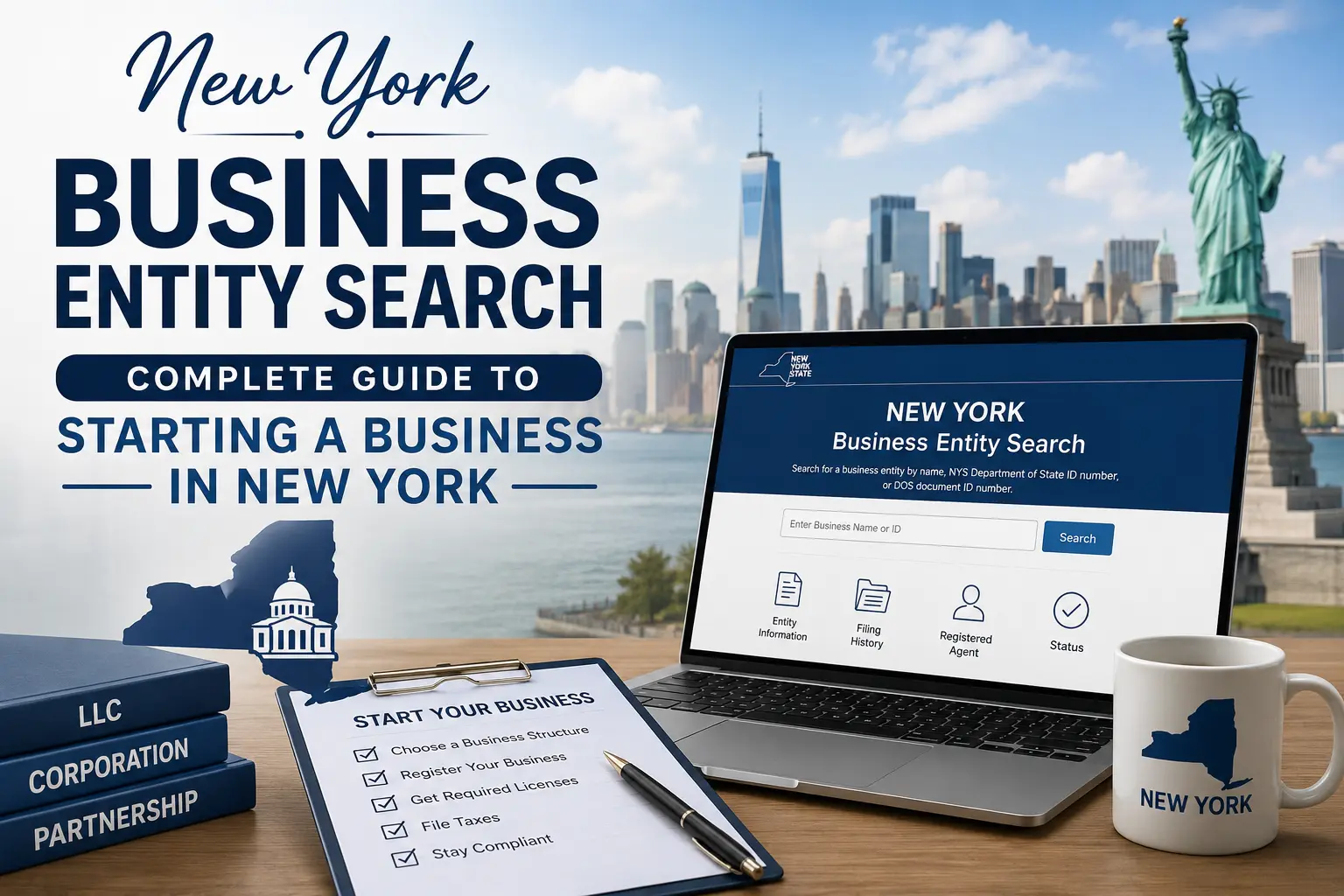
To perform a New York Secretary of State business entity search, visit the official NY Department of State (NY DOS) Corporation & Business Entity Database. Search by entity name, partial name, or DOS ID number to instantly review active status, formation dates, county locations, and designated process addresses.
If you want to verify a company, check business registration details, or confirm whether a business name is available, the new york business entity search is the official tool you need. Whether you are starting a new company, conducting due diligence, or researching an existing organization, the new york secretary of state business entity search provides direct access to public records maintained by the state,.
In this guide, we will explain how the new york state business entity search works, what information you can access, and why it is an essential resource for entrepreneurs, investors, legal professionals, and consumers,.
What Is a New York Business Entity Search?
A business entity search new york accesses an online public database maintained by the New York Department of State (NY DOS), Division of Corporations. This database catalogs all legal entities formed in New York or authorized to transact business within the state.
The database includes various business structures, such as:
- Limited Liability Companies (LLCs) and Professional LLCs (PLLCs)
- Corporations (C-Corporations, S-Corporations, and Benefit Corporations)
- Limited Partnerships (LPs) and Limited Liability Partnerships (LLPs)
- Not-for-Profit Corporations
- Foreign Entities (Out-of-state entities registered to conduct business in New York)
Note: Sole proprietorships and general partnerships are generally registered at the county clerk level rather than through the Department of State database.
Why Use the New York Secretary of State Business Entity Search?
Performing a search is a standard due diligence step in corporate transactions, compliance checks, and legal research.
- Verify Business Legitimacy: Confirm whether an entity is active and authorized to operate before signing binding agreements or executing financial transactions.
- Check Name Availability: Determine whether a proposed corporate name is distinguishable from existing registered names prior to filing formation documents.
- Perform Corporate Due Diligence: Lenders, investors, and acquirers inspect filing histories, official corporate names, and original formation dates before allocating capital.
- Identify Service of Process Address: Retrieve the official address designated by the entity for receiving legal notices and legal service.
- Confirm Statutory Compliance: Ensure target vendors, suppliers, or partners maintain active state registration status.
Step-by-Step Guide: New York Secretary of State Business Entity Search
Executing a search through the official portal involves a straightforward four-step process.
1. Access the Official NY DOS Portal:
Navigate directly to the official New York Department of State Corporation & Business Entity Database web interface.
2. Select Search Type and Enter Criteria:
Enter the business name or partial name. Searching with broader keywords yields more comprehensive query returns than typing full exact names.
3. Filter and Review Search Results:
Analyze the returned list matching your entry. The system displays matching entity names, entity types, DOS ID numbers, and status indicators.
4. Inspect the Detailed Entity Record:
Click on the specific business name to view complete public entity details, filing histories, and registered service addresses.
Also Read – What Is Machiavellianism? How It Affects Financial Decision-Making
Public Data Points Obtained via Business Entity Search New York
The database provides key administrative information derived from public state filings.
| Data Field | Description |
| Legal Entity Name | The exact legal name officially registered with New York State. |
| DOS ID Number | A unique numerical identifier assigned by the Department of State. |
| Entity Type | Specifies whether the business is an LLC, Corporation, LP, or Foreign Entity. |
| Initial Filing Date | The official date on which the entity was formed or authorized. |
| Jurisdiction | The state or country where the entity was originally formed. |
| County Location | The designated NY county where the principal office or agent resides. |
| Entity Status | Reflects current operational standing (e.g., Active, Inactive, Dissolved). |
| Service of Process Address | The official address on file to receive legal notifications. |
New York LLC Publication Requirement & Costs (Section 206)
Under Section 206 of the New York Limited Liability Company Law, newly formed or authorized LLCs must fulfill a mandatory publication requirement within 120 days of their effective formation date.
Key compliance mandates and costs include:
- County Newspaper Designation: The LLC must publish a copy of its Articles of Organization or a notice relating to its formation in two newspapers within the county where the LLC’s principal office is located. These newspapers are designated specifically by the relevant County Clerk.
- Publication Duration: The notice must run once per week for six consecutive weeks in both designated newspapers.
- Proof of Compliance: Upon completion, the publisher of each newspaper provides an Affidavit of Publication. The LLC must file these affidavits alongside a Certificate of Publication with the New York Department of State, accompanied by a $50 state filing fee.
- Estimated Costs: Newspaper publication fees vary drastically by county. In major metropolitan areas like New York County (Manhattan), total costs routinely range between $1,000 and $1,500+, whereas upstate counties generally range from $300 to $600.
- Penalty for Non-Compliance: Failure to complete the publication requirement within the statutory 120-day window results in the suspension of the LLC’s authority to carry on, conduct, or transact business in New York State.
New York LLC Transparency Act & UCC Filing Lookups
Effective January 1, 2026, the New York LLC Transparency Act (NY LLCTA) establishes specific beneficial ownership reporting rules enforced through the NY DOS.
Beneficial Ownership Disclosures under the NY LLCTA
- Scope & Compliance Requirements: Covered non-exempt LLCs registered to do business in New York must file beneficial ownership information disclosing individuals who hold substantial control or own 25% or more of the entity.
- Filing Deadlines: Entities authorized to do business in New York prior to January 1, 2026, must file their disclosures or attestations of exemption by December 31, 2026. Entities registered on or after January 1, 2026, must submit their disclosure within 30 days of registration.
- Public Database vs. Confidentiality: While basic entity filings remain public, beneficial ownership information is maintained in a secure, confidential database accessible strictly by law enforcement, regulatory agencies, and court orders.
Evaluating Debt and Financial Encumbrances via UCC Searches
- Uniform Commercial Code (UCC) Records: The state business database record does not reveal corporate debt or private balance sheets,. To assess financial liability, financial institutions cross-reference the NY DOS UCC Public Inquiry System.
- Identifying Secured Interests: A UCC-1 financing statement search reveals whether a business’s equipment, inventory, receivables, or personal property have been pledged as collateral for commercial loans, providing crucial intelligence during M&A or lending due diligence,.
Also Read – Supermaked Meaning: Definition, Origin, Uses & Examples (2026 Guide)
Business Status Meanings Explained
Understanding status terminology helps evaluate an entity’s standing,.
- Active: The entity has satisfied core filing obligations and maintains authorization to operate in New York.
- Inactive: The business is no longer operating or has voluntarily ceased operations under state filings.
- Dissolved (Voluntary or Judicial): The company has been legally terminated, either through member/shareholder action or by judicial order.
- Dissolved by Proclamation / Annulled: The state has suspended or dissolved the entity due to non-payment of franchise taxes or statutory default.
Differences Between Legal Entity Names and DBAs
A common point of confusion during entity verification is the distinction between a legal business name and an assumed name (DBA).
- Legal Entity Name: The official name recorded in the state database upon statutory filing (e.g., Empire Consulting Group, LLC).
- Assumed Name / DBA: A trade name under which a business operates that differs from its formal corporate name (e.g., Empire Digital).
If a search under a consumer-facing trade name yields no results, verify whether the business operates under a registered DBA linked to a parent corporate entity.
Public Record Limitations: What Is Not Included
While the new york secretary of state business entity search provides reliable administrative data, public access is subject to statutory privacy limitations,.
Information Not Available in the State Database:
- Private financial statements, balance sheets, and tax returns.
- Member, shareholder, or partner ownership percentages,.
- Internal operating agreements, corporate bylaws, or meeting minutes.
- Private banking details and internal accounting metrics.
For comprehensive risk assessments, state database checks should be combined with credit evaluations, background reviews, and direct document requests.