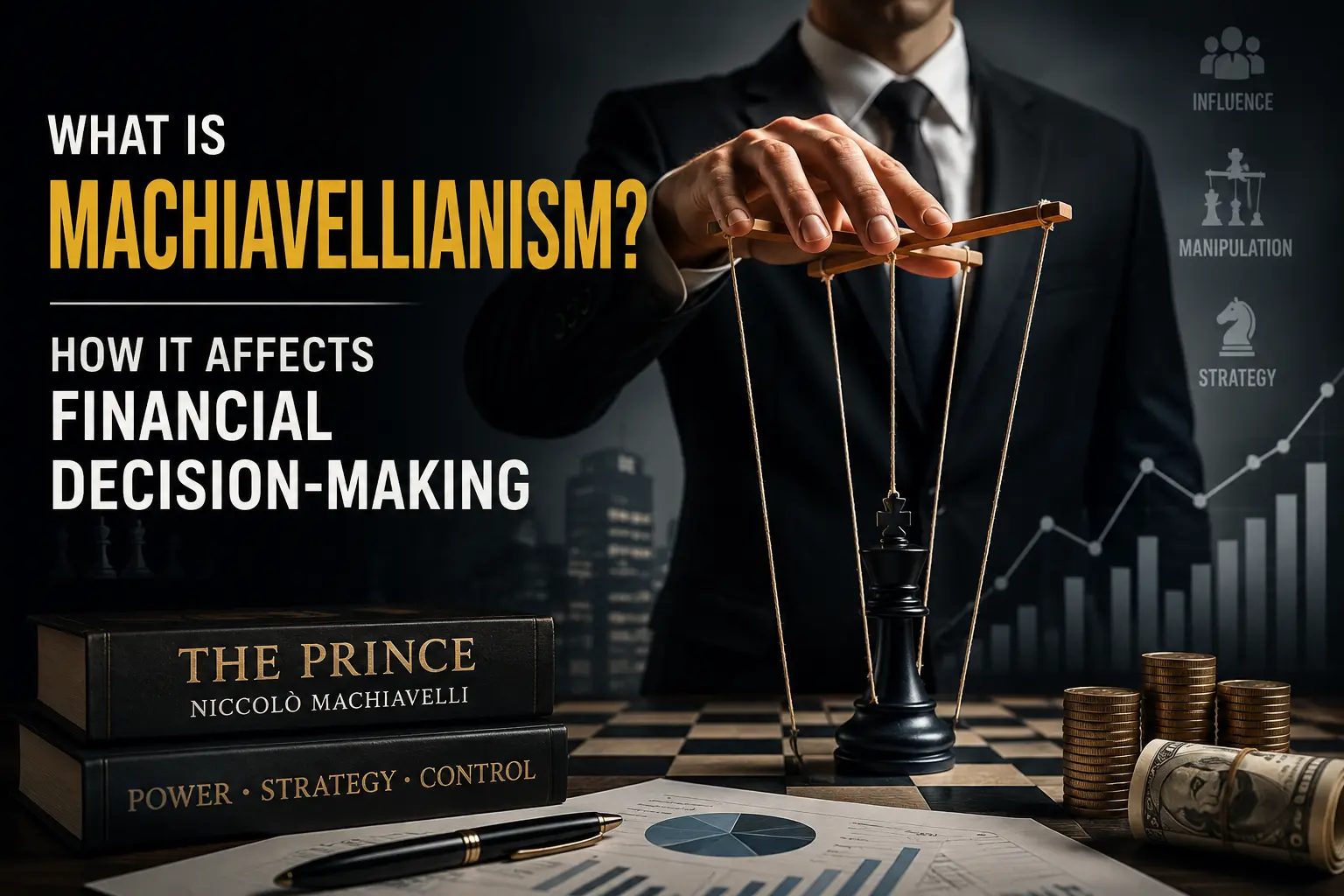
In the realm of behavioral corporate finance, understanding the dark undercurrents of executive personality profiles is critical for accurate risk assessment. Among these, Machiavellianism stands as one of the most destructive yet subtle forces in the C-suite. Named after the Renaissance political strategist Niccolò Machiavelli, this psychological trait describes a deeply calculating approach to human interaction. When embedded within corporate governance structures, a machiavellian executive can fundamentally alter capital allocation, risk tolerance, and reporting integrity.
What is Machiavellianism? The core machiavellian definition centers on a distinct personality trait characterized by a cold, calculating worldview, emotional detachment, and the systematic use of manipulation, duplicity, and strategic planning to achieve long-term personal or financial utility.
Understanding the Dark Triad in Corporate Governance
To fully comprehend the operational risk an organization faces, understanding what is machiavellianism requires analyzing it as a core component of the “Dark Triad”, a cluster of sub-clinical traits that frequently manifest in high-stakes corporate environments. While distinct in their clinical baseline metrics, these three profiles often overlap to create severe corporate vulnerabilities:
- Machiavellianism: Driven by long-term strategic planning, amoral manipulation, and opportunistic control.
- Subclinical Narcissism: Characterized by grandiose self-entitlement, vanity, and an insatiable need for systemic validation.
- Corporate Psychopathy: Defined by high impulsivity, a complete lack of remorse, and reckless externalizing behaviors.
Where the narcissist seeks applause and the psychopath seeks immediate thrill, the individual exhibiting high machiavellian tendencies plays a long-term game-theoretic strategy. They treat corporate environments as a chess board, systematically engineering asymmetric information dynamics to ensure personal utility maximization at the expense of shareholders.
How is Machiavellianism Measured? The Mach-IV Assessment
Psychologists empirically quantify these behaviors using the Mach-IV test, a twentieth-century diagnostic scale developed by psychologists Richard Christie and Florence Geis. This 20-question psychometric tool measures an individual’s level of cynical worldviews, tactical superficiality, and endorsement of manipulative tactics.
In corporate governance auditing, understanding where key decision-makers sit on this scale is vital. A high score on the Mach-IV assessment directly correlates with an individual’s willingness to exploit institutional gray areas and commit financial white-collar infractions. Academic literature demonstrates that high-Mach corporate leaders are significantly more prone to earnings management practices when executive compensation packages rely heavily on equity-based performance indicators. High-Mach actors exhibit high cognitive empathy, meaning they fully understand human emotions and organizational rules, but they completely lack emotional empathy. They use this intellectual understanding not to connect, but to execute precise impression management, smoothing over irregularities while setting up structural vulnerabilities.
Read Also: Limited Liability Partnership (LLP) Meaning
The Anatomy of a High-Mach Executive: Core Financial Manifestations
When an individual guided by a machiavellian mindset secures a position of corporate control, their psychological blueprint dictates their economic strategy. This manifestation typically unfolds across three distinct domains of transaction cost economics:
1. The Agent-Principal Conflict & Moral Hazard
The classic agent-principal conflict worsens under a high-Mach executive. Because their worldview is fundamentally transactional and zero-sum, they do not view themselves as stewards of shareholder capital. Instead, they engage in hidden actions that create severe moral hazard, altering the firm’s risk profile to secure personal bonuses while leaving investors exposed to catastrophic downside risks.
2. Strategic Information Silos & Asymmetric Information
Information is the ultimate currency in corporate finance. A Machiavellian manager deliberately creates internal data fragmentation. By keeping departments isolated, they ensure that they remain the sole bridge of communication, allowing them to leverage asymmetric information to manipulate quarterly metrics or obscure capital expenditure overruns.
3. Exploiting Transaction Cost Economics
High-Mach leaders weaponize the friction points within corporate contracts. They look for poorly defined clauses in supplier agreements, joint ventures, and executive compensation packages to extract short-term value, indifferent to the long-term degradation of the firm’s strategic partnerships.
Forensic Accounting Signals: Spotting High-Mach Fraud Early
Because high-Mach individuals excel at impression management, traditional behavioral interviews rarely expose them. Instead, risk officers must look at the financial statements. High-Mach manipulation leaves distinct forensic accounting signals across institutional records:
| Financial Area | High-Mach Behavioral Manifestation | Forensic Accounting Audit Signal |
| Revenue Recognition | Deliberate acceleration of channel-stuffing to meet short-term bonus triggers. | Unusual spikes in Q4 accounts receivable followed by massive Q1 reversals. |
| Asset Valuations | Opportunistic adjustments to goodwill and intangible assets to mask bad acquisitions. | Frequent, subjective changes to depreciation timelines and impairment models. |
| Internal Controls | Systematic bypass of established protocols via urgent, “strategic” executive overrides. | Concentration of signing authority within isolated, hand-picked internal teams. |
| Corporate Disclosures | Hyper-complex narrative footnotes designed to obscure the true nature of related-party transactions. | High density of obfuscating language and passive voice in regulatory 10-K filings. |
Case Studies in Corporate Failure: High-Mach Manipulation
To see these psychological concepts in practice, we can analyze the structural failures of historic corporate disasters. The downfalls of Enron and WorldCom were not merely lapses in calculation; they were textbook case studies of high-Mach executive behavior manipulating corporate governance loopholes.
The Enron Catastrophe: Special Purpose Entities (SPEs)
At Enron, the leadership team used highly complex game-theoretic strategies to create a web of off-balance-sheet Special Purpose Entities. This created a massive wall of asymmetric information between the executive suite, the auditors, and the public. By deliberately masking more than $1 billion in toxic corporate liabilities via these unconsolidated strategic entities, the executive leadership team artificially inflated the firm’s market value while insulating their personal options portfolios. Driven by a pure zero-sum worldview, the executives used amoral manipulation to hide debt while booking artificial mark-to-market profits. The entire system relied on aggressive impression management, maintaining a facade of innovation while the underlying capital structure was completely hollowed out.
WorldCom: The Capitalization of Operating Expenses
WorldCom’s leadership team systematically misallocated ordinary line costs as long-term capital investments. This structural manipulation allowed them to instantly inflate net income metrics. Through the strategic misclassification of approximately $3.8 billion in basic telecommunications line maintenance costs as capital expenditures, the executive team intentionally obscured collapsing gross profit margins from institutional investors. When internal auditors began to ask questions, the leadership deployed tactical superficiality and corporate pressure to isolate the whistleblowers, creating strict information silos to protect their opportunistic control until the total corporate collapse occurred.
Can Machiavellianism Ever Be Helpful? Strategy vs. Deception
From a clinical and economic standpoint, it is a mistake to label Machiavellianism purely as an unmitigated corporate evil. When properly managed and bounded by strict internal controls, sub-clinical traits associated with high-Mach profiles can be directed toward specific, high-stakes institutional utility.
High-Mach actors excel at structured, emotionless bargaining systems. In distressed M&A (Mergers and Acquisitions) deals, corporate turnarounds, or hostile restructuring environments, emotional detachment becomes an operational asset. Where an average executive might hesitate due to social friction or emotional distress, a high-Mach leader can execute necessary, clinical resource reallocations. They are immune to the psychological biases that plague standard decision-making, such as the sunk cost fallacy. However, this clinical focus only benefits the enterprise if the executive’s personal incentives are perfectly aligned with shareholder value via ironclad corporate governance frameworks.
Frequently Asked Questions (FAQs)
The four core characteristics that define what is machiavellianism across psychological and behavioral finance literature are:
Amoral Manipulation: The systemic willingness to use deceit, duplicity, and exploitative tactics to achieve personal goals, completely detached from traditional ethical boundaries.
Cynical Worldview: A fundamental belief that humanity is inherently self-serving, untrustworthy, and easily led, which high-Mach individuals use to justify their own predatory strategies.
Strategic Long-Term Orientation: Unlike impulsive psychopaths, high-Mach individuals possess immense patience, carefully calculating future moves and delaying gratification to secure major structural or financial utility.
Emotional Detachment: The ability to turn off emotional variance, allowing them to remain completely cool, analytical, and unswayed by social pressure or the distress of others during high-stakes negotiations.
In corporate finance and everyday office environments, a high-Mach individual can be identified by specific behavioral tells:
Credit Hoarding and Blame Shifting: They systematically claim credit for successful collaborative projects while engineering complex narratives to deflect failures onto subordinates.
Strategic Information Silos: They act as information gatekeepers, deliberately withholding operational context from peers to make themselves indispensable to senior management.
Calculated Relationship Mapping: They ignore peers or subordinates who offer no immediate professional leverage, focusing their charisma and impression management entirely upward toward key decision-makers.
Chameleon-like Adaptability: They shift their political views, corporate allegiances, and management styles depending on which faction currently holds power within the organization.
No, Machiavellianism is not classified as a mental illness or a clinical personality disorder in the DSM-5 (Diagnostic and Statistical Manual of Mental Disorders). Instead, psychologists treat it as a sub-clinical personality trait. It reflects a specific behavioral strategy and cognitive style rather than a psychiatric impairment. High-Mach individuals are fully aware of reality, understand social rules, and possess sharp cognitive empathy; they simply choose to navigate those systems using amoral, self-serving calculations.
While both inhabit the Dark Triad, their operational timelines and risk tolerances are completely different. A corporate psychopath is driven by high impulsivity, low self-control, and a need for immediate thrill, which often leads to sloppy, easily detected financial infractions. In contrast, a Machiavellian is defined by calculating long-term strategic planning. They are highly risk-aware and will avoid breaking laws directly if the penalty outweighs the reward. Instead, they prefer to exploit structural loopholes, gray areas, and asymmetric information, making their financial maneuvers far more calculated and difficult to detect.