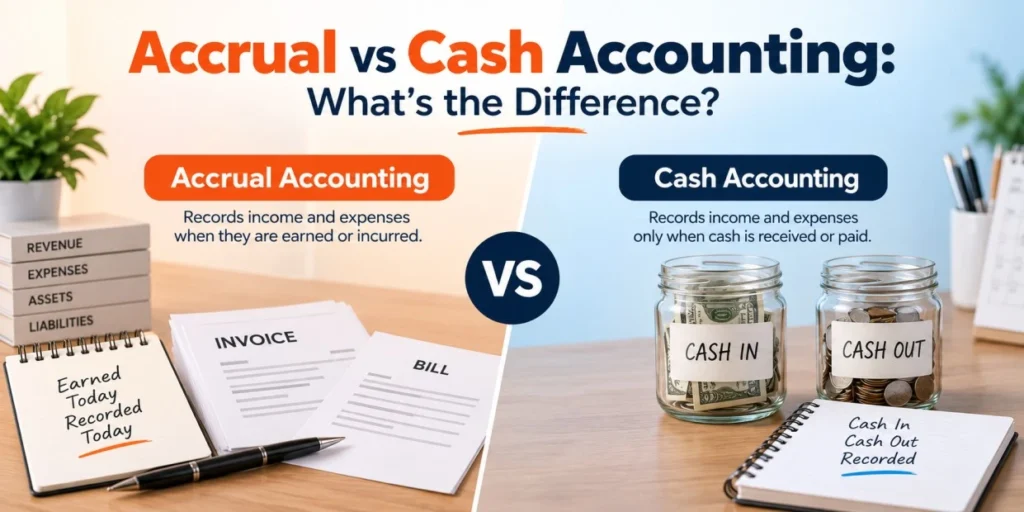
The debate between accrual vs cash accounting centers on a single variable: transaction timing. Cash accounting recognizes revenue and expenses only when liquid funds clear your bank account, whereas accrual accounting registers transactions when earned or incurred, irrespective of physical cash settlement.
Choosing the right accounting method cash vs accrual directly shapes how you file corporate taxes, track gross margins, monitor your cash conversion cycle (CCC), and present financial health to commercial underwriting teams.
Accrual vs Cash Accounting: Quick Comparison
| Feature | Cash Basis Accounting | Accrual Basis Accounting | Hybrid / Modified Cash Basis |
| Revenue Recognition | When cash is deposited | When performance obligations are satisfied (invoiced) | Cash collected (except inventory sales) |
| Expense Recognition | When payment leaves the account | When incurred (matching principle / vendor bill) | Cash paid (operating overhead) |
| A/R & A/P Tracking | Off-balance-sheet | Fully recognized on balance sheet | Recognized for inventory and direct credit |
| Tax Reporting Complexity | Low (tax based on collected receipts) | Moderate to High (tax on earned but uncollected revenue) | Moderate (requires Schedule M-1 book-to-tax reconciliation) |
| GAAP Compliance | Non-compliant | Mandatory under FASB ASC 606 | Non-compliant |
| Inventory Treatment | Expensed immediately or treated as non-incidental materials | Capitalized and matched via COGS under IRC $471 | Accrual matching reserved for inventory |
| Institutional Lending Suitability | Low (lenders routinely require accrual adjustments) | High (standard requirement for covenant tracking and underwriting) | Moderate for localized commercial relationships |
| Target Business Profile | Solopreneurs, direct-service agencies, cash retailers | Inventory-heavy businesses, SaaS, venture-backed startups | Trade contractors, multi-location clinics, inventory hybrids |
What Is Cash Basis Accounting?
Cash basis accounting recognizes income when cash is physically received and registers expenses only when payments are disbursed from company accounts.
How Cash Accounting Works
If a digital agency completes a client deliverable on December 15 and issues an invoice with Net-30 payment terms, but the client does not transfer funds until January 10, the revenue is recognized in the new tax year under cash basis rules. Similarly, vendor invoices sitting in an inbox are excluded from ledger liabilities until cash exits the operating checking account.
Advantages of Cash Accounting
- Operational Simplicity: Requires minimal double-entry accounting overhead. Transactions sync directly with standard bank feeds and automated expense rules.
- Real-Time Cash Visibility: Reflects liquid working capital on hand without adjusting for outstanding, uncollected customer receivables.
- Tax Timing Flexibility: Business owners can strategically accelerate capital expenditures or defer end-of-year billing to manage marginal tax exposure legally under IRS rules.
Disadvantages of Cash Accounting
- Distorted Operational Profitability: A reporting month featuring delayed customer collections alongside front-loaded quarterly overhead indicates a paper loss, masking healthy underlying demand.
- Omission of Liabilities: Accrued obligations, pending tax bills, and vendor trade credit remain invisible on the balance sheet until settled.
- Ineligible for Audited Financial Statements: Cash basis financial reporting violates US GAAP requirements.
Read Also: What is Accounting?
What Is Accrual Basis Accounting?
When evaluating accrual accounting vs cash accounting, accrual basis operates on the core matching principle formalized in FASB ASC Topic 606: revenue must be recognized in the reporting period in which performance obligations are satisfied, and matched against the direct expenses incurred to generate that revenue.
How Accrual Accounting Works
When you complete a contractual service or transfer control of manufactured goods, revenue is debited to Accounts Receivable (A/R) on your balance sheet, even if client credit terms extend 30, 60, or 90 days out. Conversely, when a supplier delivers raw materials or software seats, the expense hits your income statement immediately while creating an offsetting liability under Accounts Payable (A/P).
Advantages of Accrual Accounting
- True Performance Matching: Removes artificial revenue fluctuations caused by client payment processing cycles.
- Precise Unit Economics: Directly pairs milestone labor costs, work-in-progress (WIP), and raw material write-downs with the exact contract period they generated.
- Essential for Institutional Underwriting: Commercial banks, mezzanine lenders, and institutional equity sponsors mandate accrual-based balance sheets to evaluate debt service coverage ratios (DSCR) and structural liquidity.
Disadvantages of Accrual Accounting
- Phantom Income Tax Exposure: Entities risk owing quarterly income taxes on recognized earnings that remain tied up in aging Accounts Receivable collections.
- Administrative Overhead: Demands continuous adjusting journal entries, recurring revenue amortization schedules, and active monitoring of allowances for doubtful accounts.
- Obscured Cash Liquidity: A business can appear solvent and profitable on an accrual income statement while navigating a critical liquidity deficit if Days Sales Outstanding (DSO) expands excessively.
The 4 Core Types of Accruals on Your Balance Sheet
Navigating the mechanics of cash vs accrual accounting requires establishing four core working capital accounts on your general ledger:
1. Accrued Revenue (Asset)
- Balance Sheet Classification: Current Asset
- Definition: Revenue earned through completed services or shipped merchandise that has not yet been invoiced or collected.
- Example: A commercial engineering consultancy finishes structural milestone analysis on March 28. Contract stipulations dictate formal invoice submission on April 5. The revenue is recognized in March via an adjusting entry debiting Accrued Revenue (Unbilled Receivables) and crediting Service Revenue.
2. Deferred (Unearned) Revenue (Liability)
- Balance Sheet Classification: Current or Non-Current Liability
- Definition: Customer consideration received in advance of delivering goods or fulfilling contractual performance obligations.
- Example: An enterprise SaaS provider collects an upfront annual software licensing fee of $12,000 on January 1. The firm debits Cash for $12,000 and credits Deferred Revenue for $12,000. Each month, the company recognizes $1,000 as Operating Revenue while reducing the corresponding balance sheet liability.
3. Prepaid Expenses (Asset)
- Balance Sheet Classification: Current Asset
- Definition: Operating disbursements executed in advance for future economic benefits, such as commercial leases or multi-period insurance policies.
- Example: A business disburses $24,000 in December to secure commercial property coverage for the upcoming calendar year. The outlay is capitalized as a Prepaid Asset and expensed systematically at $2,000 per month across the 12-month coverage window.
4. Accrued Expenses / Liabilities (Liability)
- Balance Sheet Classification: Current Liability
- Definition: Operating expenses incurred during a financial period that have not yet been disbursed via cash or formally billed by suppliers.
- Example: Shift personnel complete work through the final week of December, but payroll disbursements execute on January 6. The controller enters a year-end adjusting entry debiting Wage Expense and crediting Accrued Payroll Liabilities to reflect labor costs in the correct operating cycle.
The Hybrid Accounting Method: A Flexible Middle Ground
The hybrid accounting method (often termed modified cash basis) integrates attributes from both frameworks.
Governed under IRS Publication 538, a taxpayer may elect a hybrid accounting framework provided it clearly reflects income and is executed consistently year-over-year. Typically, enterprises apply accrual rules to physical inventories, cost of goods sold (COGS), accounts receivable, and trade payables, while recording general administrative overhead (office leases, utilities, legal retainers) on a cash basis.
| HYBRID ACCOUNTING MODEL | |
| ACCRUAL PILLAR | CASH PILLAR |
| Physical Inventories | Facility Lease Costs |
| Cost of Goods Sold | Operational Utilities |
| Trade Accounts Payable | Brand Marketing Spend |
| Customer Receivables | Professional Retainers |
This model provides retail pharmacies, specialty surgical clinics, and field contractors with the balance-sheet discipline of accrual inventory tracking while bypassing adjusting entries for routine administrative overhead.
Real-World Comparison: Professional Services vs. Physical Inventory
To observe how the accounting method cash vs accrual changes visibility into gross margin performance, review these two common operating models:
Scenario A: Strategic Advisory Agency
- Billing Architecture: Retainer plus milestone fees invoiced on Net-30 payment terms.
- Working Capital Profile: Asset-light balance sheet, no warehoused inventory, primary operating expense is professional payroll.
- Operational Outcome: Cash-basis accounting provides sufficient operational clarity here, tracking revenue as client retainers clear the bank and deducting software and salaries as disbursed.
Scenario B: Specialty Electrical Contractor
- Billing Architecture: Construction progress billings, raw equipment procurement 60 days prior to installation, 10% contract retention.
- The Cash Illusion: The enterprise collects an initial $100,000 mobilization deposit. Under cash basis reporting, the bank account registers an immediate, artificial cash surplus.
- The Hidden Liability: Within 30 days, $85,000 in unbilled switchgear equipment arrives on-site, alongside $25,000 in accrued subcontractor labor costs.
- The Accrual Resolution: Accrual accounting maps the $100,000 progress draw against the $110,000 in incurred material and labor liabilities, surfacing a $10,000 project deficit before cash exits the clearing account.
Which Method Is Right for You? Accrual vs Cash Accounting for Small Business
When determining an accrual vs cash accounting for small business operating policy, systematically review these regulatory and transactional criteria:
- Transaction Settlement Timing: If transactions clear at the point-of-sale via merchant processing (e.g., physical food service, fitness studios), cash accounting provides streamlined operational tracking. If you extend commercial credit terms (Net-30/60), accrual accounting is required to manage unbilled revenues and track default risk.
- Inventory Capitalization: Businesses that produce, purchase, or distribute physical merchandise must capitalize inventory and match costs via COGS pursuant to IRC $471 regulations. Immediate write-offs under cash accounting risk regulatory non-compliance during an audit.
- Commercial Credit & Underwriting Requirements: If your growth plans require SBA 7(a) capitalization, commercial bank term sheets, or institutional investment, underwriters demand historical accrual statements to compute true debt service coverage.
- Statutory Gross Receipts Limitations: Under Internal Revenue Code (IRC) $448(c), C-corporations and partnerships with corporate partners that exceed the statutory 3-year average annual gross receipts threshold, indexed annually for inflation ($31 million for 2025 and $32 million for 2026), are prohibited from utilizing cash-basis accounting.
How to Switch Accounting Methods: The IRS Form 3115 Framework
Migrating an operating business from cash to accrual accounting requires formal regulatory authorization:
1. Calculate the Section 481(a) Adjustment
Quantify the net variance in taxable income as if the business had historically used accrual accounting. This adjustment combines accounts receivable, accounts payable, prepaid balances, and capitalized inventory accounts.
2. Submit IRS Form 3115
File Form 3115 (Application for Change in Accounting Method) via the automatic consent provisions outlined in Rev. Proc. 2015-13.
3. Execute Tax Adjustment Spread
A net negative adjustment (which reduces taxable income) is fully applied in the tax year the change occurs. A net positive adjustment (increasing taxable income) is typically amortized ratably over four tax years to mitigate sudden tax burdens.
4. Restructure Financial Systems
Configure your ERP or accounting ledger to automate recurring balance sheet accruals, revenue deferrals, and inventory capitalization workflows.
Frequently Asked Questions
Lenders evaluate borrower solvency based on reliable operating margins and outstanding debt commitments. Cash-basis statements obscure unpaid trade bills, accrued payroll obligations, and aging collections. Accrual accounting exposes working capital ratios, current liabilities, and operational solvency, giving credit committees a dependable basis for underwriting debt capacity.
Yes. Operating businesses frequently run accrual-basis books for monthly performance tracking and management reports, then adjust their position at fiscal year-end to file tax returns on a cash basis (assuming the business remains under statutory gross receipts limitations). This transition requires a formal Schedule M-1 or M-3 book-to-tax reconciliation prepared by a certified tax professional.
IRS Form 3115 (Application for Change in Accounting Method) is the statutory filing required by the IRS whenever a business entity formally modifies its overarching accounting method or changes the treatment of material balance sheet assets, such as inventory valuation models or depreciation schedules.
No. Generally Accepted Accounting Principles (GAAP) disallow cash basis reporting. FASB ASC Topic 606 strictly requires accrual accounting to uphold revenue recognition and expense-matching principles across all formal reporting cycles.