Understanding your cost structure is a fundamental prerequisite for effective financial planning, whether you are managing personal cash flow or directing corporate capital allocation. In financial accounting and budgeting, expenditures are broadly categorized into fixed, variable, and mixed categories.
Understanding the fixed expenses definition, reviewing real-world fixed expenses examples, and analyzing how a fixed expense behaves within a budgeting cycle will help you make data-driven financial decisions.
What Is a Fixed Expense?
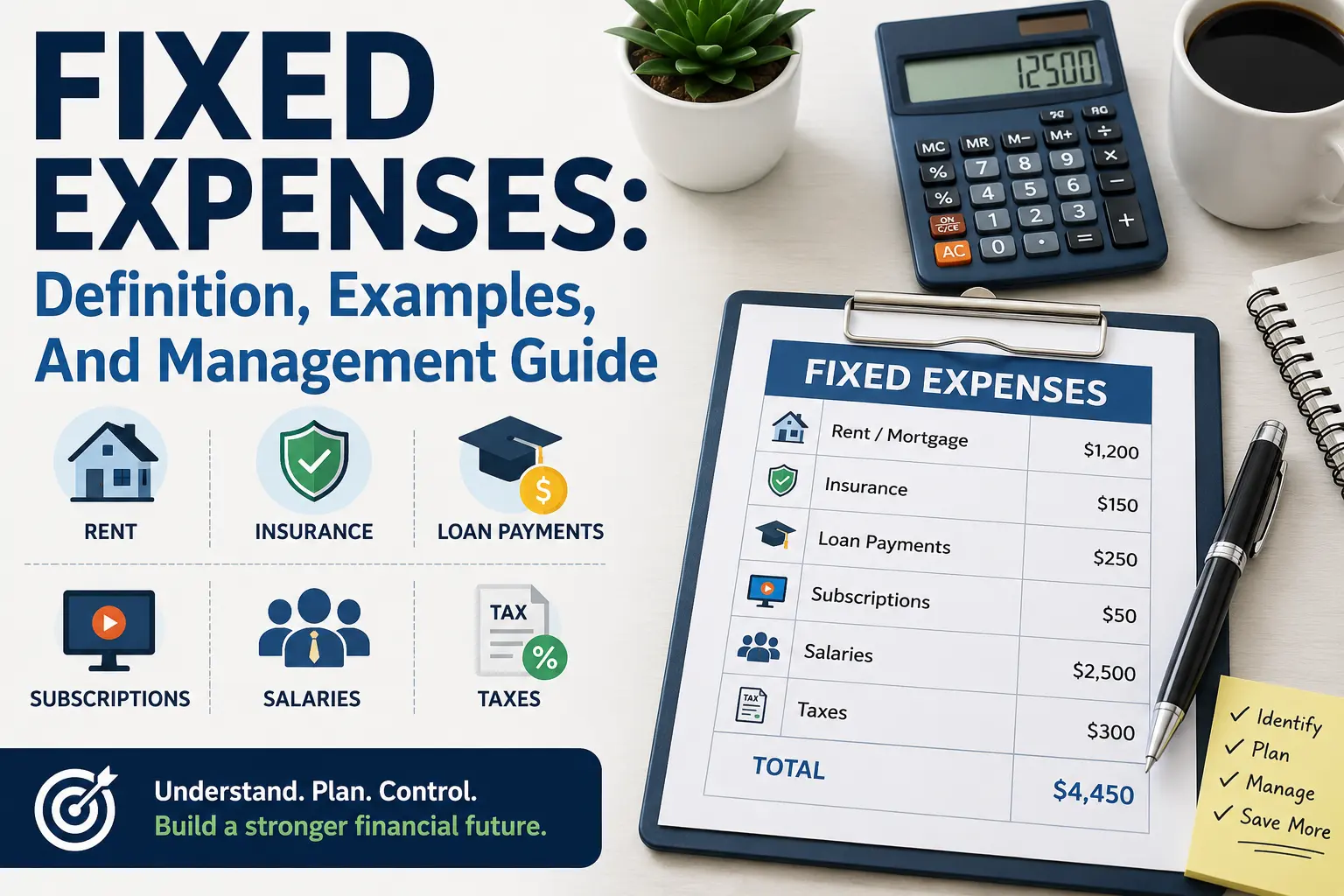
A fixed expense is a recurring, predictable cost that remains constant in total regardless of changes in sales volume, production output, or personal activity over a set period. Common examples include rent/mortgage payments, employee base salaries, insurance premiums, loan amortizations, and software subscriptions.
- Commercial real estate leases and residential mortgages
- Salaried employee payroll (excluding bonuses and overtime)
- Term debt service and installment loan EMIs
- Fixed corporate and personal insurance premiums
- Enterprise software licenses and cloud bookkeeping subscriptions
A fixed expense is an operating expense or personal cost that does not fluctuate with changes in production volume, sales activity, or consumption levels within a defined time frame or relevant range of output.
In managerial accounting, fixed expenses represent indirect or overhead costs that must be satisfied unconditionally, regardless of whether a company produces zero units or operates at maximum capacity. These recurring liabilities form your baseline commitments and dictate your mandatory monthly cash burn rate.
For instance, if an organization signs an office lease agreement requiring a payment of $5,000 per month, that charge remains $5,000 regardless of revenue performance during that month. Similarly, in personal budgeting, a fixed expense provides predictable baseline outflow commitments that must be covered before allocating capital toward discretionary or variable categories. Failing to manage these commitments as personal income grows leads directly to lifestyle inflation, which erodes discretionary income and personal savings.
Importantly, the classification of a cost as “fixed” applies within a specific accounting horizon (often one fiscal year) or contractual duration; costs can adjust over longer periods when contracts are renegotiated or rates are updated.
Fixed Expenses Definition
The standard fixed expenses definition is:
A fixed expense is an expense that remains constant in total amount across varying levels of operational activity or usage within a specific period and relevant output range.
While total fixed expenses remain constant, the fixed expense per unit decreases as production or activity volume rises, which serves as the foundation of operational economies of scale and overhead absorption.
Key Characteristics of Fixed Expenses
To accurately identify and manage a fixed expense within your financial statements or household ledger, evaluate it against three structural characteristics:
- Inflexible Time Horizon: Fixed costs are contract-bound commitments (such as a 12-month commercial lease or a 36-month equipment loan) that cannot be altered immediately without incurring early termination penalties or legal exposure.
- Priority of Payment: Because default carries severe legal, operational, or credit consequences, fixed expenses are paid first before allocating funds to variable operational expenses or discretionary spending.
- Independent of Output Volume: Whether a retail store serves 10 customers or 10,000 customers in a given week, total fixed costs like store rent and core property insurance remain identical.
Common Fixed Expenses Examples
Both personal household budgets and enterprise income statements feature predictable overhead requirements. The following fixed expenses examples illustrate how these costs appear in practice:
1. Housing and Commercial Real Estate Leases
- Residential Leases & Fixed-Rate Mortgages: Monthly apartment rent or the principal-and-interest portion of a fixed-rate mortgage remains static across the contract term. This represents the single largest cost of living commitment for most households.
- Commercial Real Estate Leases: Standard multi-year commercial lease agreements establish contracted baseline facility costs for corporate operations.
2. Insurance Premiums
- Corporate Policies: General liability, directors and officers (D&O), and commercial property insurance.
- Personal Policies: Fixed periodic premiums across auto, health, term life, and homeowners insurance policies.
3. Debt Service Obligations
- Amortized Debt: Fixed-rate term loans, equipment financing agreements, and installment notes require uniform monthly equated monthly installments (EMIs) covering principal and interest amortizations over their lifecycle.
4. Enterprise Software and Subscriptions
- SaaS and Enterprise Tools: Fixed annual or monthly recurring licensing fees (such as enterprise resource planning software, cloud bookkeeping software, project management tools, or consumer subscriptions) that do not scale with transactional bandwidth.
5. Salaried Compensation and Retainers
- Exempt Salaries: Base salaries for administrative, executive, and non-hourly staff represent fixed personnel costs that do not scale directly with output volume. However, associated employer payroll taxes and benefits tied directly to these base salaries also function as fixed overhead commitments.
- Professional Retainers: Fixed monthly retainers for corporate legal counsel, accounting, or advisory services.
6. Depreciation and Amortization
- Asset Write-Offs: Under straight-line depreciation methods, non-cash depreciation and amortization expenses remain constant throughout an asset’s useful life.
Read Also – What Is Machiavellianism? How It Affects Financial Decision-Making
Fixed Expense vs. Variable Expense vs. Semi-Variable Expense
To optimize budgeting precision, financial managers distinguish between fixed, variable, and semi-variable (mixed) cost components.
| Attribute | Fixed Expense | Variable Expense | Semi-Variable / Mixed Expense |
| Behavior relative to volume | Remains unchanged in total regardless of output level. | Fluctuates in direct proportion to production or activity. | Contains a fixed baseline charge plus a variable fee tied to usage. |
| Unit Cost Dynamics | Per-unit cost decreases as activity increases. | Per-unit cost remains relatively constant. | Per-unit cost decreases initially, then levels out as usage scales. |
| Typical Examples | Rent, salaried payroll, insurance premiums. | Raw materials, direct piece-rate labor, sales commissions, packaging. | Utility bills (base grid access fee + kWh usage), fleet costs (lease + fuel), salesperson pay (base salary + commission). |
| Budgeting Predictability | High short-term predictability. | Dependent on operational throughput and market demand. | Moderate predictability; baseline is fixed, but usage fluctuates monthly. |
| Cost Management Focus | Managed via strategic capacity planning and contract negotiation. | Managed via operational efficiency and supply-chain controls. | Managed by minimizing base subscription tiers and auditing monthly consumption spikes. |
The Risk of High Fixed Costs: Cash Runway and Operational Leverage
Operating with excessive fixed expenses directly amplifies a business’s structural vulnerability during macroeconomic downturns. Understanding the relationship between fixed costs, operational leverage, and cash runway is critical for enterprise survival.
1. Operational Leverage: The Two-Sided Coin
When a company has high fixed costs relative to variable costs, it exhibits a high degree of operating leverage (DOL). As revenue expands above the break-even threshold, each additional dollar of sales flows rapidly to operating income because variable costs are low. However, this dynamic cuts both ways: when sales drop, profits plunge exponentially faster because fixed overhead cannot be reduced quickly.
2. Brick-and-Mortar vs. eCommerce Cost Structure Comparison
- Brick-and-Mortar Retailer (High Fixed Overhead): Carries massive fixed expenses including commercial storefront rent, physical security, equipment leases, and permanent store staff. During a sales slump, these obligations remain 100% due, rapidly burning cash reserves.
- eCommerce Retailer (Low Fixed / High Variable Structure): Relies on third-party logistics (3PL) warehousing where costs scale directly with order volume, cloud-based software, and performance-based marketing. If demand drops, fulfillment fees and ad spend decrease automatically, preserving working capital buffer.
3. Zero-Revenue Survival and Cash Runway
Your company’s cash runway measures how many months operations can survive if all revenue drops to zero :
Cash Runway (Months) = Total Liquid Cash Reserves/Monthly Fixed Expenses + Minimum Unavoidable Overhead
A business burdened with $100,000 in monthly fixed commitments and $300,000 in reserves has an absolute runway of 3 months in a zero-revenue shock. Lowering baseline recurring liabilities directly extends solvency and business continuity.
Read Also – New York Business Entity Search: Complete Guide to Starting a Business in New York
Why Understanding Fixed Expenses Is Important
Categorizing and monitoring fixed expenses provides foundational data required for several strategic finance processes:
- Break-Even Analysis: Identifying total fixed costs allows businesses to calculate their break-even volume—the exact revenue threshold needed to cover total costs where operating profit equals zero.
- Operating Leverage Optimization: A higher proportion of fixed costs creates operational leverage, enabling larger profit margins as sales grow beyond the break-even threshold.
- Emergency Fund Sizing: For personal financial planning, calculating baseline fixed commitments determines the precise capital required for a 3- to 6-month emergency reserve.
- Liquidity and Solvency Risk Management: High committed overhead limits flexibility during economic contractions or unexpected revenue shortfalls, elevating financial risk.
How to Calculate Total Fixed Expenses
To calculate total fixed expenses over an accounting period, aggregate all independent overhead obligations using this baseline formula:
Total Fixed Expenses=∑(Facility Leases+Base Salaries+Debt Service+Insurance Premiums+Fixed Retainers/Subscriptions)
Example Calculation
Consider the following monthly overhead schedule for an operational business unit:
- Facility Lease: $3,500
- Salaried Payroll (Base): $8,000
- Commercial Equipment Loan: $1,200
- Liability Insurance: $400
- Software Licenses: $300
Total Fixed Expenses = 3,500 + 8,000 + 1,200 + 400 + 300 = 13,400 per month
Once baseline fixed commitments are calculated, net operating income can be determined by subtracting both fixed and variable costs from total gross revenue.
4 Tactical Ways to Reduce and Renegotiate Fixed Expenses
While fixed expenses are contractual, proactive financial managers routinely employ four tactics to structurally reduce their recurring overhead:
- Vendor Contract Re-Tendering & Negotiation: Never allow enterprise contracts to auto-renew without competitive bidding. Request RFP proposals from rival vendors 90 days before renewal to force concessions or extended payment terms on facility services, insurance, and telecommunications.
- SaaS License Auditing to Combat Software Sprawl: Conduct quarterly usage reviews across all enterprise software seats. Downgrade or decommission inactive user seats, eliminate redundant project management tools, and negotiate multi-year discounts for essential cloud bookkeeping tools.
- Debt Refinancing and Loan Restructuring: Refinance high-rate equipment loans or commercial notes during favorable credit cycles to lower the interest rate or extend amortization schedules, directly reducing your monthly EMI obligation.
- Subleasing and Footprint Rationalization: If remote or hybrid work leaves excess commercial office space vacant, negotiate sublease agreements to offset monthly lease obligations, or negotiate with landlords for a smaller footprint prior to lease maturity.
Managing Fixed Expenses Over the Long Term
While a fixed expense does not vary in the short term based on activity, it is not permanently static:
- Contract Expirations: Lease agreements, vendor contracts, and insurance rates typically reset at renewal dates.
- Step-Fixed Costs (Step Costs): When operations expand beyond a critical capacity threshold, fixed overhead steps up to a higher baseline (e.g., leasing an additional warehouse or hiring an extra shift manager once manufacturing reaches 85% capacity) .
- Strategic Downsizing: Organizations facing structural declines can adjust fixed obligations through lease renegotiations, equipment refinancing, or workforce restructurings.